Saturday, 10 January 2015

Patterning interconnectedness


This quilt that I made a few years ago, resulted from piecing together many fabrics. It was fun to design and to sew, and now fulfilling to enjoy the finished product on a bed in my home. However since reading Karen Barad’s work, I look at it in a different way. Is this a finished product? What does it tell me and what more could I have done or still do? How does it influence my thoughts?  For instance, the backing has a very different force on me with a bright orange energy. To continue to sit with these questions, I have kept the photo in its raw state choosing to let it facilitate my diffractive thinking.

Similarly in my research proposal I stated the type of data collection that would suit my research and the appropriate analysis that I anticipated would elicit the best results. Now I wonder how reading diffractively will change and influence how I consider the multiple intra-actions that occur in my classroom and online pedagogical practices, and the clinical context of student learning. It feels that my thoughts are shifting in an unexpected way. Where will this lead and how does one capture the different differences when all matter matters?


Deleuze and Guattari (1987) write about the relational aspects in a pieced quilt - considered as a smooth space without a centred focus. Lenz Taguchi (2010:145).expands on how different patterns and fabrics relate to each other “in different and infinitely possible ways”. In working with and on my research data, I will need to make choices in defining the “agential cuts”, or will the choosing be a consequence of other forces (Barad 2007). I wonder what patterns, possibilities and potentialities will emerge?

Tuesday, 6 January 2015

Boundary break-in


“The nature and existence of boundary spaces is both challenging and troublesome because they are borderland spaces, spaces where diverse and related concerns both overlap and collide” (Savin-Baden 2008:115).

Maintaining safe spaces is an important concern in my research and work. In creating such spaces for dialogue and reflection, I recognize that boundaries become increasingly relevant and important.

From my own point of view, I am in a "liminal space" engaging in troublesome knowledge and dissonance. I am challenging established practices as an outside insider - not an Obstetrician, midwife or a full-time educator. In facilitating student learning in and through health and human rights workshops at several levels of the undergraduate medical curriculum, I bring an alternative “liquid curriculum” that provides a smooth space in a generally crowded striated curriculum.

Yet the issues are complex, troublesome and difficult. Connections between the university, the province and non-governmental organizations are sensitive. Furthermore, the relationships between the students, nurses and doctors is fragile. Part of my research is to explore the impact of students’ learning on the already stressed and overworked nursing staff in the Obstetrics facilities.

In terms of changing educational practices, Savin-Badin (2008:116) recommends that we provide 2 types of boundary spaces - space creation in the curriculum and space production referring to “gaps for students thinking, reflecting and student-led discussion”. New boundary spaces can be considered as in-between spaces, “where criticality, debate and deliberative democracy can grow and flourish” (2008:127).

The photos in the Picframe collage, were taken while I was walking in my neighbourhood. The barbed fences are not uncommon in South Africa. However this and many other strategies to “keep out crime” have limited value in a country where poverty and inequality provoke high incidents of crime.

Looking through the looped coils, I see many stories unraveling as my research progresses. Collegial support is likely to help me to develop the resilience to overcome the barbs. My new iPad also contributes to shield me from other limitations.


Savin-Baden, M. 2008. Learning Spaces: Creating opportunities for knowledge creation in academic life. McGraw-Hill.

Thursday, 1 January 2015

Towards different differences


A nudge from my supervisors has led me to consider my research as an institutional ethnographic study. This appeals to me because it is “about looking out beyond the everyday [practices] to discover how it came to happen as it does” (Smith 2006:3). This approach aims to illuminate organizations and relationships and to understand the “embodied actualities” of the work people do that I can then relate to student learning. Dorothy Smith suggests that we begin with ourselves which is usually something that I tend to avoid.

Taking a selfie on the first day of 2015 (and adding some graphics on Notability) helps me share some thoughts about the data collection that is planned for the next few months. What will the unintended consequences be as I shift into this phase of the PhD? There are likely to be many entanglements through the interactions of different actors and the intra-actions that I am able to identify and discern or possibly miss.

Although like others, I usually choose not to be different, my visual impairment does impact on my research. It is frequently an invisible disability to others only surfacing when I need to read text or reach a destination with assistance. Transport to outlying places is a concern. In terms of my data collection I recognize that in small groups I can miss visual cues. Therefore I need to rely on the transcribed text and on the images I hope to produce as a research product of my own and others. If I asked an observer to be present during my interviews and focus groups, my sense is that it will negatively impact on the rapport between me and my research participants.

More broadly there is recognition that the past plays out in the present. I come from a previous workplace situation where fair labour practices were sometimes questionable. I became conscious of the different value given to truthfulness by different people and the powerlessness of some to promote change. These personal experiences acted as a catalyst to my research trajectory.

Now I am curious, cautious and cognisant of the responsibilities that I carry as a researcher, educator, learner and change agent as the new year unfolds with all its possibilities.

Smith, D. 2006. Institutional ethnography as practice. Rowman & Littlefield Publishers


Tuesday, 16 December 2014

Drawing meanings from drawings

Drawing meanings from drawings


The potential for using drawings to interrogate practices in medical education is becoming more and more appealing as I delve into this modality. While images in terms of diagrams and imaging are integral components to medical training, asking individuals to draw on their experiences, thoughts and feelings through drawings is not common.

In our Faculty we have used drawings in a limited way with first year students. For several years I was asked to instruct my small group of students to draw their personal development illustrating their learning in a semester course. These images were interesting with frequent reference to metaphors such as growing beans, meandering rivers and flowers opening up. Thick wax crayons were used as cost was always a big concern.  I began to question how authentic such evaluations were, and whether we were actually rather facilitating students’ strategic actions to complete a desired task to please their teacher. As the facilitator of student learning, I grew to dislike the materiality of the crayons as it placed a childish perspective to the many course tasks that had potential. Later I introduced alternative stationery to offer more choice to the students.

In 2013 I used the title of this blog for a presentation at the Higher Education Learning and Teaching in South Africa (HELTASA) conference in Pretoria. It was a small part of a collaborative group project organized by our course facilitators from a professional development course run by the Cape Consortium for Higher Education (CHEC). This presentation is on Slideshare at http://www.slideshare.net/VeronicaMitchell/drawing-meanings-from-drawings

Through recent involvement in two collaborative research projects where drawings are integral to the processes, my interest has been reignited. When we can better integrate personal insights and experiences into the drawings, they can become exceptionally meaningful with useful sense-making of situations. Last week I had the opportunity to ask 13 educators in the Faculty to create their individual drawings responding to a video clip from our Head of Department, now on YouTube at  http://youtu.be/kwBDT1JElWY 

Above is my simple and quick drawing indicating the ladder of 6 years of study that comprises the medical curriculum.  The majority of students enter the Faculty with great ambitions to be caring and to make a positive impact on health, yet along the climb and after graduation, there are many uncertainties and huge challenges that they face in our public health system that frequently leave them floundering sometimes resulting in them climbing off the ladder or at times falling.

My personal observations from these recent drawing projects:
Ø    Engagement with the task of drawing varies: some people dive in with great enthusiasm and others are frozen with uncertainty
Ø    Paper size: some use the large A2 option while others fold up the sheet to work on a smaller, more defined surface
Ø    Types of images: people, nature and conceptual representations indicate the varying connections made by individuals
Ø    Focus: Some avoid the real issues such as prevailing tensions using alternative images while others dig deeply into interrogating issues through their images
Ø    Colours: The choice of colour seems to be significant. For instance, monochromatic may indicate a single perspective as opposed to multiple colours and textures reflecting the complexities
Ø    Emotion: sometimes clearly evident, sometimes emerging through the oral description of the image, and other times missing

It feels like drawings can offer deeper insights than photos but are more challenging to elicit.


Wednesday, 3 December 2014

Reflective diffractions


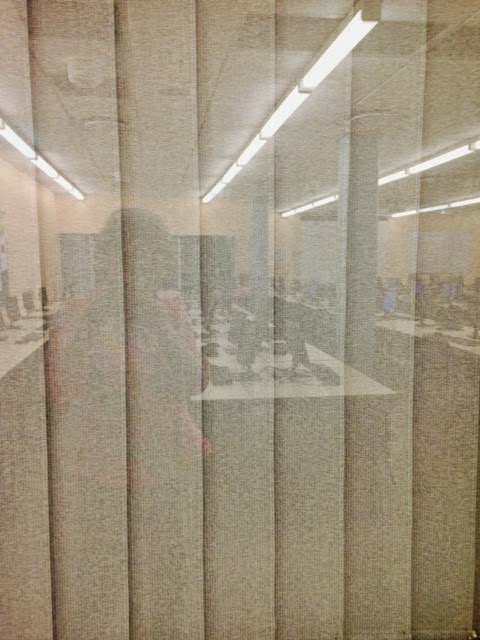
An introduction to the methodological theory of diffraction in Karen Barad’s book, Meeting the universe halfway (2007) is shifting my gaze. These photos were taken on different days this week in our Faculty computer lab. They indicate the complexity of relationships and the intra-actions between myself (reflected in the first photo) and the material objects around me. The glass, the light and the position of the vertical blinds illuminate different stances as I stand in the same position on both days.

At our recent research project retreat in the beautiful Stellenbosch area, we grappled with ideas and concepts and alternative points of view. The space facilitated such interactions – while uncomfortable, they were meaningful. I came away with personal experience of how we can gain deeper insights through disruption of the status quo yet in many instances it is not allowed. Although resilience and agency are perceived as important characteristics to enhance our pedagogical interactions, care and compassion with creativity to engage in uncertainty seem paramount.


Monday, 24 November 2014

Student saturation

Displaying FullSizeRender.jpg

Recently I sent out my research survey questions to a selected group of students. The Google form was accessible through a tinyurl mailed to the students. It was created attractively to add appeal by using relevant images and colour, and asked for 10 minutes of the students’ time. Like my pilot survey only 2 students responded. However unlike previously, a follow-up note using the mail merge add-on did not elicit more responses. While the subject of my research is related to students’ experiences and many have indicated a keenness to bring change, I'm wondering why the response rate was so poor.

Are senior students saturated by the numerous requests for evaluation, feedback and research participation? Involvement in research is voluntary so they have every right to refrain from participation yet this does have serious implication for a PhD project that hinges on the students' experiences in engaging with the curriculum. 

Perhaps students have become emotionally detached.  Individual achievement and motivation to succeed in the course can override broader concerns such as becoming part of a community of inquiry for change. Timing is a factor that I now recognize as crucial. Final year-end exams and the beginning of a short summer vacation are not conducive to responding to extra requests. I will retry the survey at the start of 2015 when students are refreshed and inspired to face new challenges.

As the link between emotions and affect becomes clearer, I consider alternative strategies to encourage students to feel empowered to act beyond the confines of the designed curriculum.


Monday, 3 November 2014

A thorny issue


A thorn bush in the northern areas of South Africa seems to be a significant symbol for the problem of disrespect in Obstetrics, which is not straight forward, rather complex with multiple prongs. There is a need to draw on the different perspectives, from different angles in terms of the behavior and attitudes of the many actors, as well as engaging with emotions. 

Stepping into one of these thorn bushes is extremely painful, initiating a sharp reaction. A prick, a jab or a deep gash may result in lasting pain and discomfort. Similarly negative experiences of birthing can have detrimental consequences for mums, students, midwives and others involved.

The silencing of these practices seems to demonstrate an unwillingness to engage in difficult issues, perhaps the emotional labour is too unsettling. It feels like we are conditioned to keep our distance from the thorns, to stay away, which appears to exacerbate the “othering” of relationships.


Is the medical curriculum providing the space and opportunity for students to develop the muscle to recognize the thorns and bounce off them, or teaching and building resilience to insulate future doctors from harm, or shifting away from discomfort to accomplish the requisite knowledge and skills at the expense of other competencies?