Friday, 26 June 2015

Mindfulness matters


You could say that mindfulness is like a personal app that allows you to see what's playing out in your mind whenever you pause to notice it. Without this awareness, the unnoticed thoughts, beliefs, memories, and feelings sit at the control panel of your mind, pushing your buttons and controlling your behaviors”.
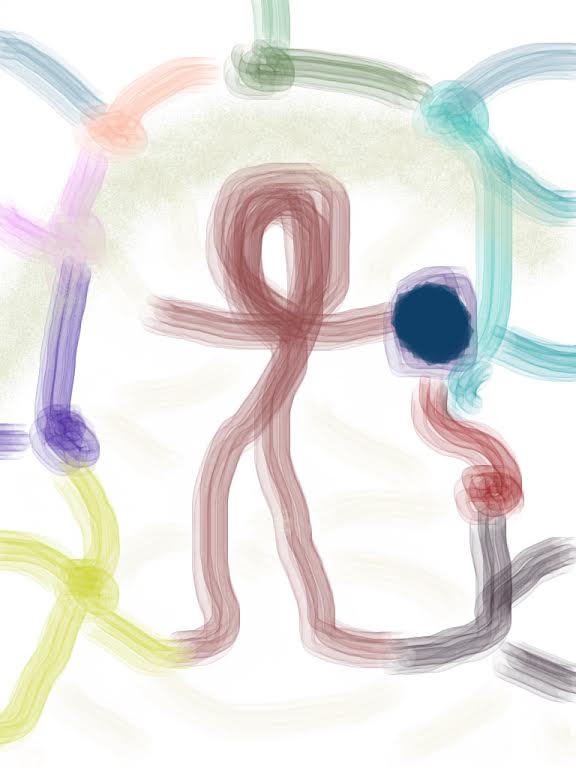
When many forces converge with the same message, it is time to consciously recognize the importance of that line of thinking and engage with it, as indicated by the image above (drawn on my iPad using the Mindmap App Fluent MM then adding layers with Adobe ideas). A recent online writing workshop with HASTAC highlighted (through Amanda Strauss’’ presentation) the value of mindfulness in our work. In my interviews with educators I have been referred to mindfulness by three research participants. A midwife drew a picture indicating the balance needed between soul matters and information, a doctor involved at a non-governmental organization (Perinatal Mental Health Project ) shared the value of mindfulness as a strategy for engaging with individual’s lifestories, and our Head of the Department of Obstetrics and Gynaecology handed me papers on mindfulness in education at the end of our interview.
Last week I used an open access resource with my students. It was a recording of a mindfulness exercise. The impact of those 7 minutes was significant. A number of students made themselves comfortable lying on the floor while others came to speak to me afterwards. There was a different flow of energy that permeated our being and becoming. Ergas (2015) encourages us to engage with the lived experience of education rather than the structured curricular process which tends to be seen as linear.
Jon Kabat-Zinn is renowned for his work at the Massachusetts Medical School where he developed a Mindfulness-Based Stress Reduction (MBSR) programme in 1979. However it was only in the 1990s that mindfulness started making an increasingly important impact in education. Now in 2015, educators in all disciplines including Obstetrics are asking how it can be incorporated into curricular and pedagogical practices. Hyland (2015:171) reminds us that mindfulness “simply means ‘paying attention in a particular way: on purpose, in the present moment and nonjudgmentally’ in a way which ‘nurtures greater awareness, clarity, and acceptance of present-moment reality’”.
By using contemplative practices Ergas (2015:204) points out that we “are introducing an alternative curricular deliberation; one that inevitably challenges the very concept of ‘curriculum’ as a ‘course of study’ and its implications to our conception of life-meaning and where we ought to look for it (in here and/or out there).”.... It is about dwelling in the here and now, and gradually realising that there is no place ‘better’ than now. Paradoxically, this is a radical critique of the very essence of the ‘curriculum’, which inevitably proposes that reaching the ‘end’ of ‘the course of study’ will in effect bring us to a ‘better’ time and place”.

Ergas,O. 2015.  The Deeper Teachings of Mindfulness.  Journal of Philosophy of Education. 49:2..

Hyland, T. 2015. On the Contemporary Applications of Mindfulness: Some Implications for Education. Journal of Philosophy of Education. 49:2.

Tuesday, 16 June 2015

Curriculum as orchid


The mapping of the curriculum in medical education is an important process. Yet there is an assumption that what is taught (as reflected in the documents) will be representative of students’ learning experiences – a tracing of the requirements to become a good Doctor.

In the image above (drawn on my iPad using flowpaper) I consider the medical curriculum as the Deleuzian orchid that opens up with complexity through the years. If the students are Deleuzian wasps who interact with the curriculum at different places, then the in-between space of becoming-curriculum and becoming-doctor can be explored rhizomatically. In the process of learning there are movements of indeterminancy.

“The rhizome is altogether different, a map and not a tracing…. The orchid does not reproduce the tracing of the wasp; it forms a map with the wasp, in a rhizome. What distinguishes the map from the tracing is that it is entirely oriented toward an experimentation in contact with the real. The map does not reproduce an unconscious closed in upon itself; it constructs the unconscious. It fosters connections between fields, the removal of blockages on bodies without organs, the maximum opening of bodies without organs onto a plane of consistency. It is itself a part of the rhizome. The map is open and connectable in all of its dimensions; it is detachable, reversible, susceptible to constant modification. It can be torn, reversed, adapted to any kind of mounting, reworked by an individual, group, or social formation” (Deleuze & Guattari (1987:12).

Similarly our students are open to the influences of the practices they observe when immersed in their Obstetrics practical rotation. When a midwife chooses to watch television in preference to attending to the needs of a woman in pain or when a Doctor does not ensure informed consent before a procedure, these actions leave marks on students, like sticking pollen.

“The orchid deterritorializes by forming an image, a tracing of a wasp; but the wasp reterritorializes on that image. The wasp is nevertheless derritorialized, becoming a piece in the orchid's reproductive apparatus. But it reterritorializes the orchid by transporting its pollen. Wasp and orchid, as heterogeneous elements, form a rhizome. It could be said that the orchid imitates the wasp, reproducing its image in a signifying fashion (mimesis, mimicry, lure, etc.). … At the same time, something else entirely is going on: not imitation at all but a capture of code, surplus value of code, an increase in valence, a veritable becoming, a becoming-wasp of the orchid and a becoming-orchid of the wasp. Each of these becomings brings about the deterritorialization of one term and the reterritorialization of the other; the two becomings interlink and form relays in a circulation of intensities pushing the deterritorialization ever further (Deleuze & Guattari 1987:11).

In the rhizomatic connection between the students and the curriculum, I question whether the relationship is presently fostering the acceptance of injustice to women in labour. When students write about their unwillingness to respond to wrong-doing (by those who are meant to teach them), it reflects the impact for both now and later – leaving pollen on their being and becoming. This choice of inaction takes on a form of protection for themselves towards advancement in the course objectives. In order to bring change towards developing a socially just curriculum, we need to consider the reciprocal-becoming in the orchid-wasp/curriculum-student relationship.


Deleuze, G., & Guattari. F. 1987. A thousand plateaus: Capitalism and schizophrenia. Trans. B. Massumi. Minneapolis, MN: University of Minnesota Press.

Thursday, 4 June 2015

Folding and unfolding in the findings

“we must learn to live in the middle of things, 
in the tension of conflict and confusion and possibility; 
and we must become adept at making do with the messiness 
of that condition and at finding agency within… “ (St Pierre 1997:176)


As I hear about the events related to student learning in Obstetrics, I am thrown into the folds of the unfolding data. Through this process of data collection, I feel myself becoming immersed in the currents that flow - some together, some in alternate directions, yet all moving me through the tide towards change in myself and in the process of intra-activity. There are interdependent and mutually constituted forces that effect each other through the affect on each other (Barad 2007). I was told that even the ripples emanating from this research project are raising awareness by contributing to an increased consciousness of students’ engagement with the curriculum in Obstetrics and beyond. This is an affirmative stance compared to the potential for drowning in sorrow from the tsunami of despair. Findings from a public inquiry by the South African Human Rights Commission (2009:4) to investigate the realization of the right to access health care illuminated the “lamentable state of many public hospitals in the country”; reasons suggested included “a shortage of trained health care workers, a lack of drugs in clinics, lengthy waiting periods that patients endure before receiving treatment, poor infrastructure, a disregard for patients’ rights, a shortage of ambulance services and poor hospital management”.

Beyond these limitations is the disjuncture in the capabilities of health providers. Recently an interviewee described her insights. She explained that after our previous interaction, she had been thinking about the realities of disrespect in the profession, now more clearly identifying that “what is ailing” in the healthcare profession is the issue of relationships. She shared a personal story reflecting the expertise and skill of colleagues in procedures yet their limitation in coping with loss. There was exceptional interprofessional collaboration when knowledge and skills were used, yet as the events unfolded, exclusions and separability became evident.

Strength in some areas of expertise produce lines of flight that then exclude other areas. There are rupturing connections between different bodies - a cutting-together and apart (Barad 2007). In terms of student learning, there are many obstacles such as an objectification of the curriculum and the students’ immersion in it. Perhaps their logbooks act as lifejackets carrying them through the tides, as they learn to strategically weather the storms and swim through the waves and the backwash - embedded in the processes. As facilitators of learning, perhaps we can take more time to acclimatize students to the conditions by presenting them with the reality, allowing them to tread the waters, feel the temperatures, and connect to the material-discursive practices of the discipline with and through each other.

The image above was drawn on the Stetches App on my iPad using my finger rather than a pen. The photos taken as selfies were cropped then inserted into the image symbolizing my becoming-researcher and becoming-curriculum.


Barad, K. 2007. Meeting the universe halfway: Quantum physics and the entanglement of
matter and meaning. Durham, NC: Duke University Press.


South African Human Rights Commission. 2009. Public inquiry: Access to health care services. http://www.sahrc.org.za/home/21/files/Health%20Report.pdf

St Pierre, E. A. 1997. Methodology in the fold and the irruption of transgressive data.

Saturday, 30 May 2015

Positioning mattering

a bed.jpg

“Space, time and matter are mutually constituted through the dynamics of iterative intra-actions” (Barad 2007:181).

These entangled intra-actions seem to be illuminated in Obstetrics.

In a classroom session this week I observed junior students’ representations of the birthing phenomenon in a collection of their free drawings. Their images reflected the controversial topic of positioning in labour, foregrounding widely held beliefs and assumption that mothers give birth from a supine position.

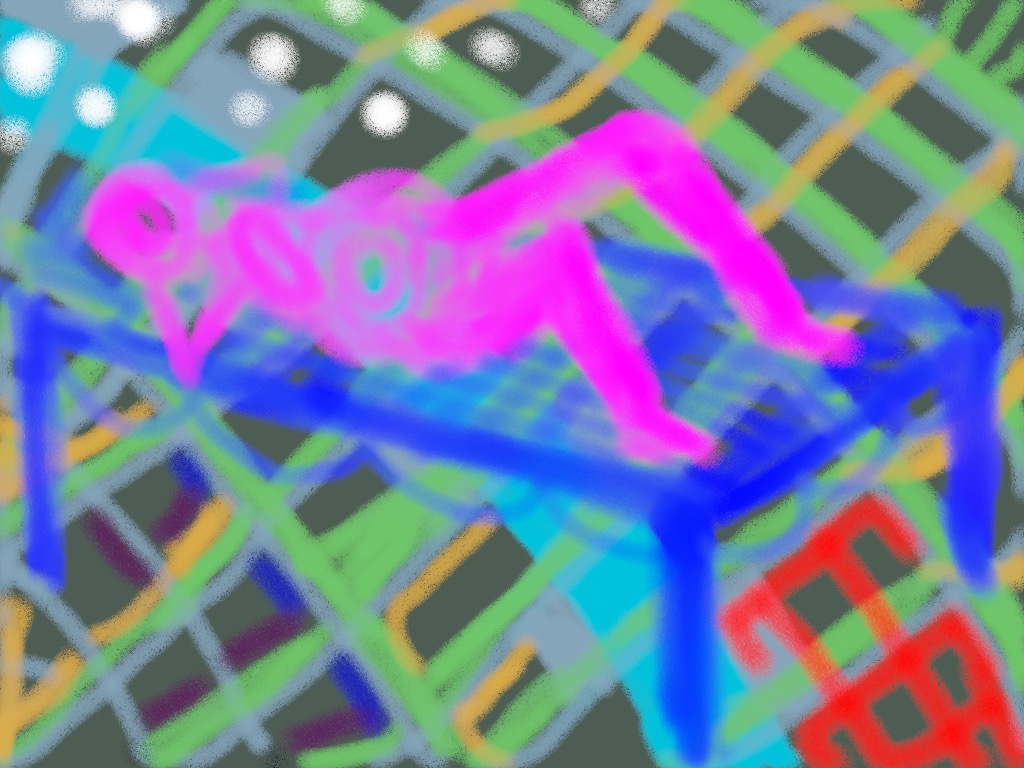
Similarly, a couple of the participants in my research project have centred a bed in their drawings, placing a woman lying in a crook position, as indicated in the image above (drawn on my iPad using the Pastels App). The bed appears as the focal point for the birthing process and associated procedures.

Yet there is evidence to suggest that mobility and alternative positioning facilitates the birthing process. However the bed remains an important apparatus especially with the medicalization of labour where regular monitoring of the foetal heart is prioritized. It is easier to manage this and other measurements when women are horizontal.
The choice of positioning in labour remains contested as a result of many influences. There are conflicting views in terms of mobility during the different phases of labour. What I hear from my midwifery colleagues is that walking, sitting and finding alternative positions is preferable for the health of the foetus and the mother. An innovative initiative in Peru has shifted practices in maternal healthcare to accommodate cultural beliefs. This has led to a significant drop in maternal mortality rates. Previously, when the horizontal position was forced onto women in labour, the indigenous women chose to stay at home for their birthing experiences despite the many associated risks particularly in rural areas. In their homes, these women could adhere to their cultural tradition of vertical positioning without the fear of opposing forces at public health facilities.  Since the Health Ministry in Peru adopted new policies that facilitate alternative positioning, more women are attending the facilities resulting in reduced mortality rates - a valued move in governmental support towards health promotion and respect for women’s rights. http://its.uvm.edu/Vertical%20Birth/Vertical%20Birth.html


Barad, K. 2007. Meeting the universe halfway: Quantum physics and the entanglement of matter and meaning. Durham, NC: Duke University Press.

Saturday, 23 May 2015

Time for tea


“We must make matter matter, not only in science but in society as well”
(Hekman, 2008:116)

As I look into the folds of practice where students are learning about/for Obstetrics, small matters that seem insignificant do become relevant, demonstrating material agency in their entanglements and inter-relationalities. One such example is the cup of tea/coffee.

Barad (2007:390) states that
“We are responsible for the world of which we are a part, not because it is an arbitrary construction of our choosing but because reality is sedimented out of particular practices that we have a role in shaping and through which we are shaped”.

Near the start of my interest in this work, a student mentioned how special it was to be invited into the nurses’ tearoom for a cup of tea during her Obstetrics rotation. This action/intra-action seemed to break into/through disciplinary and power differences thereby enabling this student to feel welcomed into a space that was traditionally seen as a “no space” for students. Shared tea in a communal space became an affirmative action towards developing mutual responsibility in teaching and learning. There was a reconstitution of a boundary.

In a  learning brief produced by the Perinatal Mental Health Project, based in Cape Town, there is a recommendation for health workers to find time for tea and to “step outside for your tea break” as a self-care strategy.

But what happens when tea time and drinking tea/coffee has more force and power than the needs of women in labour? Barad (2007:390) calls for a posthumanist ethics in terms of responsibility which she asserts “is the ability to respond to the other”. To explore an understanding of the material-discursive practices that do occur in Obstetrics, the phenomenon of tea/coffee drinking can be helpful. Besides the establishment of social relations, there are detrimental consequences when the drinking of tea overrides the necessity to provide care when it is needed. The material arrangements in facilities seem to contribute to such choices when the dynamic interplay of the cup and the health worker takes preference and therefore  excludes other intra-actions, constituting “changing conditions of possibility of changing possibilities” (Barad 2007:179).


The image above (drawn on my iPad using the Draw App then Adobe Ideas) reflects Barad’s (2007:181) metaphor of the tree rings - “evocative of the sedimenting process of becoming”. The past is always present with us. What students witness and experience in their training continues to impact on their future practice as a doctor. The drawing also reminds me of contour paths representing the iterative process of becoming, with different gradients and intensities. Pickering (1995:113) points out that “the contours of material agency emerge only in practice”.

Barad, K. 2007. Meeting the universe halfway: Quantum physics and the entanglement of
matter and meaning. Durham, NC: Duke University Press.

Hekman, S. J.. 2008. Constructing the Ballast: An ontology for feminism.  In S. Alaimo & S. J. Hekman (Eds.), Material Feminisms (pp 85-119). Indiana University Press. Bloomington.

Perinatal Mental Health Project. 2013. Caring for health workers. Learning brief. http://pmhp.za.org/wp-content/uploads/2015/01/Leaflet_HealthWorkers.pdf

Pickering, A. 1995. The Mangle of Practice: Time, Agency, and Science. University of Chicago Press.

Sunday, 17 May 2015

Me and my iPad

BwO image.jpg
“Bodies assemble and disassemble as they are machined through desire” (Clark 2012:210).

Desire is expressed by Clark (2012:202) in an affirmative way as the “magnetic attraction between bodies”. My iPad is a vital part/extension of me. When I use the potentials and engage with the affordances of the tablet (especially in terms of drawing) then the creative ‘artwork’ appears to open up my thinking through theory and practice. This communication seems to generate flows of intensity and affective entanglements.

I recognize the formation of an assemblage in/between myself and the tablet, towards a plane of consistency (Deleuze & Guattari 1987). This creative encounter enables me to be sensitive to the forces and flows through their mutual intelligibility (Barad 2007). The concept of a Body without Organs (BwO) is helpful in terms of the distribution of intensities, through the taking away of obstructions (Deleuze & Guattari 2987). It indicates an ideal limit that is unreachable. Yet the potential multiplicities and ambiguities provide a positive flow beyond blockage points and nodes of disruption.

There are two phases in the construction of a BwO, named by Clark (2012) as experimentation and becoming (Deleuze & Guattari 1987). The former explains the process of “finding pieces with which to connect and experiment” (2012:203). My drawings are spontaneous and free. I do not plan them or predict what they will look like. They are generated as I think through/with the materiality of the tablet, any time, any place. There appears to be a dual flow of affect through the fabrication of imagining images.

In the latter phase, my becoming, the process facilitates my action “to make something circulate on it or pass across it” (Deleuze & Guattari 1987:152). Through the relationship of my iPad and me, there is an energy that opens up the in-between space (Clark 2012). This experience becomes a movement that is a force in my becoming.which is open to new possibilities.

The image above (drawn on my iPad using the Brushes App) attempts to illustrate the disarticulation apparently happening in the generated assemblage. The unanticipated flows of intensities prevail as I explore art and images through visual text. There appears to be “freeing lines of flight, causing conjugated flows to pass and escape and bringing forth continuous intensities for a BwO” … with a  “connection of desires, conjunction of flows, continuum of intensities” (Deleuze & Guattari 1987:161). This production of a minoritarian assemblage resembling my becoming-researcher, becoming-art-creator, becoming-iPad contrasts with the established majoritarian assemblages that foreground binaries such as self/other and researcher/data (Clark 2012). As the process moves forward, I look forward to gaining a deeper understanding of these elements.

Barad, K. 2007. Meeting the universe halfway: Quantum physics and the entanglement of
matter and meaning. Durham, NC: Duke University Press.

Clark, V. 2012. Art practice as possible worlds. International Journal of Child, Youth and Family Studies (2012) 2 & 3: 198–213.

Deleuze, G., & Guattari. F. 1987. A thousand plateaus: Capitalism and schizophrenia.
Trans. B. Massumi. Minneapolis, MN: University of Minnesota Press.

Saturday, 9 May 2015

Citing circles

spiral.png

Vicious circles of abuse, concentric circles of influence, life circles of identities combine with spirals of learning. These relationships mesh in/through/to spheres in uncertain ways. There are blurring lines between the circles and spirals as they move in/between each other. My research and teaching is cutting in/to a moment in student learning - a blob/node in the curriculum that acts with intensity, through affect, to effect the becoming doctor, often a lifetime. Conversations with doctors who have many years of experience indicate how Obstetrics changed them, stained them and remained with them - a memory/mark.

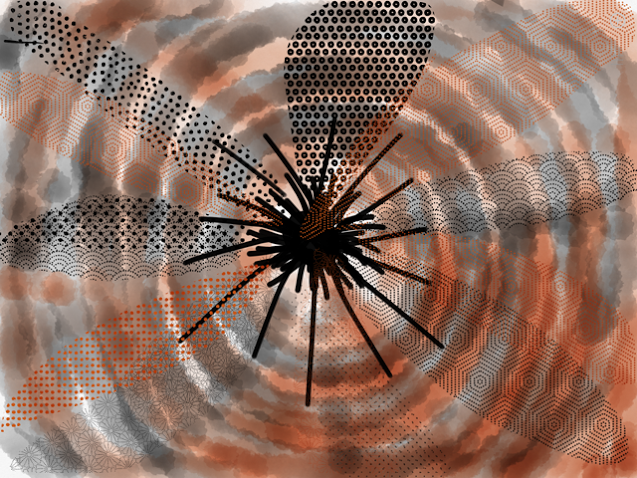
In the image above (created on my iPad using Sketches), I crack a peephole into my teaching experiences. This takes me along lines that touch/feel/see and explore students’ learning experiences. The darkness of this peephole is illuminated by the impact of sharing.

When I draw on students’ personal learning experiences from incidents in their Obstetrics rotation, I encourage them to engage in meaningful dialogue with their clinical partners who become their critical friends. Students voice their insights and their narratives to/with each other. There appear to be overlapping circles that are shifting darkness into light.  Feedback indicates the positive responses as perspectives are changed and expanded. There is a refocus, like the changing lenses used by Ophthalmologists, sliding/slipping between/in/through each other to improve our vision, enhancing self-evaluation and open-mindedness (Costas & Kallick 1993).


Costa, A. & Kallick, B.1993. Through the Lens of a Critical Friend, Educational Leadership 51:2: 49–51.