Monday, 2 November 2015

Giving and receiving gratitude


“Gratitude is both a response to moral behavior and a motivator of moral behavior” (McCullough et al 2001:250).

Last week a student walked up to me near campus and with a beaming expression keenly told me how much she had appreciated our discussions in the recent focus group. She mentioned sharing her learning and experience with others. She feels more connected with different aspects of her learning. A video recording of our conversation could have captured this special moment where I felt drawn in by the student’s warmth and gratitude.  

I question why, as health educators we tend to give more space and time for criticism than appreciation? The health system is governed by regulatory practices focused on accountability to indicate measures of quality. Similarly, the education system is driven by assessment processes to maintain requisite standards. It becomes apparent that expressions of care and kindness are often missing, perhaps oppressed by power and regulation within the hierarchy of medicine. There seems scope for more time to be spent on gratitude, an emotion that is incorporated in the growing movement of positive psychology and mindfulness.

In Obstetrics many students have commented on the joy they felt as recipients of gratitude. For instance even after a traumatic delivery when the student was left with a feeling of helplessness, there was a sense of worth when thanked by the new mother. A small act of kindness has a large impact. I continue to question why this is notable rather than naturally forthcoming.

While reading students' reflective commentaries over the past 4 years, it has struck me how much they value gestures of gratitude. These have been demonstrated in different ways such as a baby named after the student or simply a thank you for being present at a vital time. In recognizing the value of gratitude, our department now sends out complimentary notes to individual nurses in the birthing facilities who students identify as being special educators and role models.

Zournazi (2002) relates gratitude to ethical and political responsibilities suggesting that “it is through our everyday experiences and choices that gratitude manifests in its subtle as well as substantive forms” (2013:287). In a similar vein, Braidotti (2013) writes about affirmative ethics and Barad (2007) about the need to interrogate our intra-actions in a positive manner looking in on the finer details and connections rather than critique.

Recent studies using stories of kindness and compassion from personal narratives related to the Holocaust have indicated the neurological changes that are triggered through acts of gratitude (Fox et al 2015). Shariatmadari (2015), editor of The Guardian, refers to this study in his column where he questions the under-valuing of gratitude, suggesting that it could be the most important social emotion and ought to get more attention. Wood, Froh and Geraghty (2010) point out how under-researched gratitude is, yet it could become “a key element for sparking positive changes in individuals, families, and organizations” (Bono et al 2003:272).

Using Baradian concepts, perhaps gratitude can be described as an appreciation of the entanglement of our intra-actions when our in/separate roles coalesce; an apparent apartness that is made visible by the coming-together through choice rather than obligation (Barad 2007). In Obstetrics, the act of birthing can become a moment of superposition creating a lasting memory which impacts on the being and becoming mother/doctor. If we delve deeper into the relationships ”to feel what lurks in the interstices” (Stengers in Zournazi 2002:145) there can be a sense of hope and appreciation of the value gained from the togetherness of mother, infant, helper and the materialities in the intra-actions that transpire.

McCullough et al. (2001:250) put forward three reasons for giving more attention to gratitude.
  1. It is used less than other positive emotions
  2. It is experienced and expressed in a large variety of ways both in local and global contexts due to cultural differences
  3. It relates to “a good outcome as a result of the actions of another person” (2001:250)

In developing a socially just pedagogy, it seems that gratitude can become an important component to create a culture of appreciation that can complement hope for change.

The image above was drawn on the iPad using Adobe Ideas App. It highlights how we can breathe gratitude through our actions and intra-actions.


Barad, K. 2007. Meeting the universe halfway: Quantum physics and the entanglement of matter and meaning. Durham, NC: Duke University Press.

Bono, G., Emmons, R. A. & McCullough, M. E. 2004. Gratitude in Practice and the Practice of Gratitude. In (Eds.) P. A. Linley & S. Joseph. Positive Psychology in Practice. John WIley & Sons, New Jersey. 464-481.

Fox, G.R., Kaplan, J., Damasio, H. & Damasio A. 2015. Neural correlates of gratitude. Frontiers in Psychology. Retrieved  http://journal.frontiersin.org/article/10.3389/fpsyg.2015.01491/full

McCullough, M. E., Kilpatrick, S. D., Emmons, R. A. & Larson, B. 2001. Is Gratitude a Moral Affect? Psychological Bulletin. 127:2:249-266.

Shariatmadari, D. 2015. Could gratitude be the most important emotion of all? The Guardian. 30th October.

Wood, A. M., Froh, J. J. & Geraghty, A. W. A. 2010. Gratitude and well-being: A review and theoretical integration. Clinical Psychology Review. doi:10.1016/j.cpr.2010.03.005.

Zournazi, M. 2003. Hope: New philosophies for change. New York. Routledge.

Zournazi, M. 2013. Critical Hopes – gratitude and the magic of encounter. In (Eds). V. Bozalek, R. Carolissen, B. Liebowitz & M. Boler. Discerning Critical Hope. Routledge.


Saturday, 24 October 2015

Sense awareness


The image above was drawn on the 3D App on my iPad. It reminds me of the long, thin balloons that I used to love twisting and shaping in my play as a child. It introduces this blog post which considers the sensuality of learning.

What lingers after a learning experience such as Obstetrics? Barad’s (2007) concept of material-discursive practices seems to offer a valuable tool to unpack what is happening to our students in their curricular encounters. There are intra-actions that extend beyond the confines of the designed curriculum learning outcomes, even beyond the informal and hidden curricula (Hafferty 1998). Peterson (2014) explains that “agencies do not precede their intra-action but instead emerge through it”. In my understanding, each individual student is immersed in a process of learning in which they are affected and in which they affect their clinical encounters in a dynamic and uncontained way. Through a theoretical lens of new materialism the curriculum can be considered as an open-ended apparatus, defined by Barad (2007:148, cited by Peterson 2014) as “the material conditions of possibility and impossibility of mattering; [that] enact[s] what matters and what is excluded from mattering”.

One aspect that I explore here is the impact of the senses in Obstetrics curricular learning. For instance on the one hand the smell of the placenta lingers, the feel of a macerated foetus is discomforting, the sight of a foetal anomaly is both intriguing and upsetting, and hearing frightened teenage mums being scolded by angry midwives leaves students feeling guilty and disempowered. On the other hand the joyful touch of a healthy newborn, the sight of a blue neonate becoming pink as the body is aerated, and the pleasure embraced through hugs of gratitude bring a sense of elation, increased self-confidence and inner resourcefulness to students.

Recently a colleague has used the senses as the theme for third year students to prepare for their entry into Obstetrics the following year. She asked students to draw texts and images reflecting what they anticipate in terms of seeing, hearing, smelling, touching and occasionally tasting in Obstetrics. Surprisingly this activity did not make much impact, and was not well received by other educators.

What can we do differently to educate for the sensitivities of real world professional practice?

Barad, K. 2007. Meeting the universe halfway: Quantum physics and the entanglement of matter and meaning. Durham, NC: Duke University Press.

Hafferty, F. 1998. Beyond Curriculum Reform: Confronting Medicine's Hidden Curriculum. Academic Medicine. 73:4::403-407.

Peterson, K.S.  2014. Interviews as intraviews: A hand puppet approach to studying processes of inclusion and exclusion among children in kindergarten. Reconceptualizing Educational Research Methodology. 5:1:32-45.

Sunday, 18 October 2015

Stillness of stillbirth


Death is “a point in a creative synthesis of flows, energies and becomings” (Braidotti 2006.235).

While there are many different cultural rituals associated with death, in the obstetrics’ environment other factors appear to surface exacerbating the loss of a newborn.  Death seems to have a particular force and intensity that contributes to a “pushing away” of some people. This often results in a lonely grieving process for the mother and those around her including students. Stories of neglect are not infrequent. In recent focus groups, students have indicated how they were shocked at times by the distancing of relationships when they expected support and care. 

Students have noticed an avoidance of death when it occurs and question themselves and each other about this practice. Nicola Fouche (2014) explains that even critical care nurses who frequently confront death, struggle with the discomfort, even after many years of exposure to dying patients. In her recent doctoral thesis she recommended that nursing training ought to include a special curricular module on death studies, named as Thanatology.

Braidotti (2001:121) puts forward an affirmative posthuman theory of death claiming that we “need to re-think death, the ultimate subtraction”, and rather to consider the death-life continuum that can blur the divide between life and death. Studying death is a relatively new interdisciplinary area emerging since the 1970s and is “under-examined as a term in critical theory” (Braidotti 2001:128). Braidotti (2001:121) criticizes the “forensic turn” for placing an “over-emphasis on death”. She refers to zoe, a generative force that creates a vital continuum with relationships of interconnectiveness that can be helpful for compassionate care.

The blurring of bodily boundaries is also part of Karen Barad's (2012:218) affirmative philosophy in which she relates materiality to indeterminancies that can be “a celebration of the plentitude of nothingness” rather than a lack or a loss. The image above shows a footprint illustrating a practice carried out by some midwives. This material-discursive practice promotes compassionate care through the mark of the deceased baby’s foot. There is an assemblage created by the baby’s skin-ink-print-paper-becoming that provides a lasting memory keeping alive the loss, rather than being a no-go sign. This image drawn on the Papers App on my iPad illustrates how spacetimemattering can be diffracted with different effects.

Barad, K. 2012. On touching: The inhuman that therefore I am. A Journal of Feminist Cultural Studies. 25:3:206-223.

Braidotti, R. 2006 Transpositions on nomadic ethics. Polity Press, Cambridge, UK.

Braidotti, R. 2013. The Posthuman. Cambridge: Polity Press.

Fouche, N. 2014. “We don't handle death well": Implications for a postgraduate nursing curriculum of intensive care nurses' experience of death in ICU. University of Cape Town. https://open.uct.ac.za/handle/11427/13185

Sunday, 11 October 2015

Deciding on diffraction

When two stones or more are dropped into a pool simultaneously, the resultant ripples of water that appear in concentric circles, move outwards and interfere with each other. These ripples also produce patterns that move with the flow, in a process that can be described as diffraction (Barad 2007). In contrast, still water that has not been disturbed can create mirror-like reflections -- a static product, mediated by light waves. On the other hand, refraction refers to the bending and splitting of light when lights waves move through different mediums and change speed. In this process there is a separation or dispersion of the waves, sometimes visible through rainbow colours.
The interactions of all forms of matter are recognized as important contributors to our insights and our actions. Like waves interfering with each other through the diffractive process, we can pull our research theories and data through each other to distinguish different patterns. This offers a new, alternative approach that shifts away from separation and stasis. It can be informative in facilitating difference to make a difference (Barad 2007). There is a growing and emerging interest in using diffractive methodologies for research in different disciplines. This shift takes research beyond a “conventional humanistic qualitative methodology” by expanding into the non-human materiality of matter and the interrelating relationships (Denzin & Lincolm 2011).
Feminist scholar Donna Haraway first considered diffraction as a valuable metaphor for feminist research in 1992 (Kaiser & Thiele 2014).  The notion of diffraction as a process in physics that can be related to philosophical understandings was further picked up by Karen Barad and taken forward through observations in quantum physics. Barad draws on the experimental work of Niels Bohr and other influential physicists to explain diffraction as “not a set pattern, but rather an iterative (re)configuring of patterns of differentiating-entangling” (Barad 2014:168). She explains meanings from the relationships in the entanglement of patterns of interference describing how matter matters by going beyond the geometrics that is associated with the optics of diffraction. It is a strong move away from traditional binary conceptions that tend to relate difference to something that is not the same, an otherness that has led to limiting dualist viewpoints such as shadow versus light, cause/effect, human/non-human amongst others.
Diffraction pushes outwards in a powerful way to illuminate differences and the spaces in-between. Diffraction encapsulates the dynamic complexity of the entanglement of space, time and all kinds of matter and includes a strong ethical component embedded in the relationships of the patterns of difference. For instance Barad (2012:68)  asserts “that our responsibility to questions of social justice have to be thought about in terms of a different kind of causality”.
The notion of cause and effect is expanded. When waves in the ocean crash against an obstacle they become superimposed on each other and can produce bigger waves or other variations of amplitude that depend on their timing, positioning and force amongst other influences. There is a multitude of possible responses to the waves interacting with each other. How this is interpreted depends on our viewpoints, perspectives and measuring processes.
In my research project I plan to identify differences through the intra-acting patterns that emerge. I will explore insights through one another to find “new patterns of thinking-being” (Barad 2012:58). This diffractive methodology acknowledges that I as the researcher will be immersed in the data, and through my developing relationships will be likely to become transformed in indeterminate and different ways, rather than assuming a distance from the data in a neutral and objective manner. The researchers take up a “responsibility to the entanglements of which we are a part” (Barad  2012:52).
In this appealing process there is a positive component that develops in the construction and deconstruction of phenomena that make up the patterns, and relate to each other, through connections that form, what Deleuze and Guattari (1987) term assemblages. This contrasts with some other critical stances that can be undermining through their binary conceptions that give value to some data and knowledge and discard other. Kaiser and Thiele (2014:166) suggest that “thinking-with-diffraction” opens up affirmative potentials to be a “subject-shifter”.
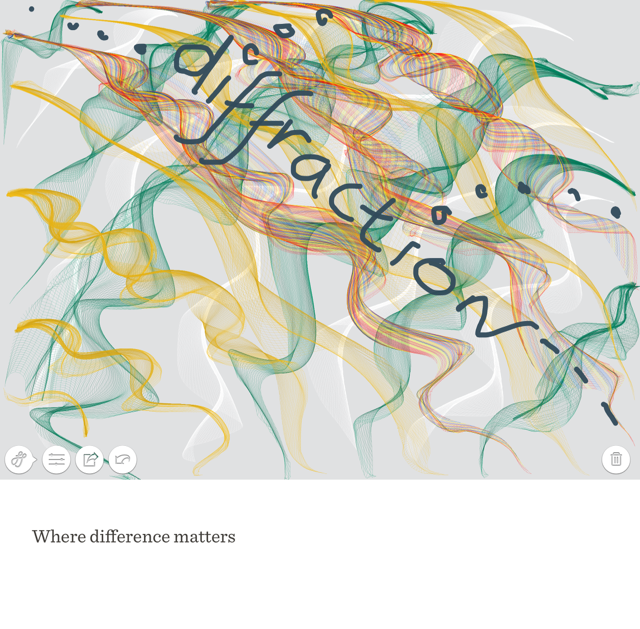
The image above was created on my iPad using the Flowpaper App. The drawing was imported into the Paper App where additional elements were added like the text.

Barad, K. 2014. Diffracting diffraction: Cutting together-apart. Parallax. 20:2:168-187. 

Barad, K. 2007. Meeting the universe halfway: Quantum physics and the entanglement of
matter and meaning. Durham, NC: Duke University Press.
Barad, K. 2012. “Matter feels, converses, suffers, desires, yearns and remembers” Interview with Karen Barad. In Dolphijn & Van der Tuin, New Materialism: Interviews & Cartographies. Open Humanities Press.

Deleuze, G., & Guattari. F. 1987. A thousand plateaus: Capitalism and schizophrenia. Trans. B. Massumi. Minneapolis, MN: University of Minnesota Press.

Kaiser, B. M. & Thiele, K. 2014. Diffraction: OntoEpistemology, Quantum Physics and the Critical Humanities, Parallax, 20:3:165-167.
St Pierre, E. 2011. Post qualitative research: the critique and the coming after. 2011. In Denzin & Lincoln (Eds), 4th Ed. The Sage Handbook of Qualitative Research.


Saturday, 3 October 2015

The stick

a stick photo.jpg

The in-between space in this doctoral research project seems to feel like a wandering in the forest with different paths to follow amidst the beauty of the vegetation. I stop, look, feel, smell, then move on with a varying pace. The route is uncertain and untracked. There is no well-trodden path to follow nor a Google map or GPS to guide me to a specific place.

Sitting down gives me a chance to reflect and digest the beauty and the movements around me but it does not lead me to my destination. Climbing a tree can offer an overview, a panoramic perspective of where I ought to be going or give clarity to potential possibilities. I need to move with intention yet I stumble as I question which way to go. Which desires do I follow? The maze of paths that connect in different ways can be compared to Deleuze and Guattari’s rhizome. The growth and life around me inhabiting the forest offer encounters that I am experiencing as I read the transcripts and listen to the audio-recordings of my interviews and focus groups.

As the light illuminates different parts of the forest, new insights become visible in differing ways. Through my being and becoming aware of the relevant patterns and interferences I am engaged in a diffractive approach to my research analysis. Various forces and intensities open up channels of evidence that can lead me to reach my destination, my research objectives.

As I sit in the midst of my research data, I feel a sense of entanglement, caught in the branches and the foliage that seem to be holding me back, yet affecting me in a manner that is pushing and pulling me to experiment, to find something new. McClure recommends that in post-qualitative research we need to be sensitive to the glow of the data, what “arrests our gaze and makes us pause” (2013:662). Davies suggests that in data analysis we engage with the “entanglement of intra-active encounters” (2014:2). I feel reassured as she contends that it is “ hard epistemological, ontological, and ethical work to enable the not-yet known to emerge in the spaces of the research encounter”.

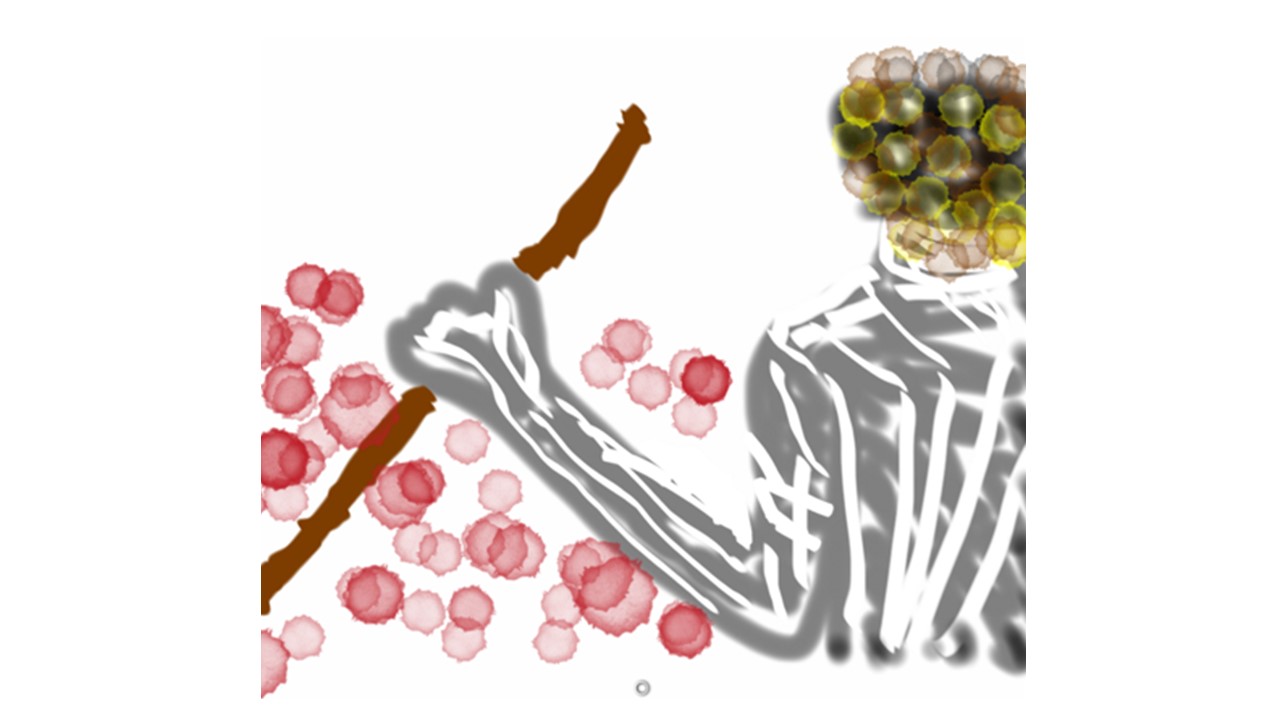
What struck me this week was the significance of a stick. In an interview with a student he explained how difficult relationships play out in the medical hierarchy between midwives and medical students, where midwives appear to give preference to nursing students. This was also a strong theme in a recent student focus group. The student reflecting on his obstetrics experience said “you feel like there’s a certain judgment that comes with being a medical student that you must be a medical student so you must be like every other medical students or every other doctor I've met in my life. So we just carry the stick with us …  so everywhere we go we represent a bigger group of people”. The stick represents punishment that he relates to possible past experiences of relationship issues between nurses and doctors. The image above was drawn using Sketchbook Pro on my iPad.

Punishment seems prevalent in the maternity facilities. Kruger and Schoombee (2010) write about the various forms of punishment. There is neglect and abandonment, as well as physical and verbal abuse of women in labour. Kim and Motsei (2002) report that nurses themselves are victims of abuse/punishment by partners who feel threatened by the nurse’s professionalism and independent income generation. Beating is sometimes viewed as an acceptable form of discipline and punishment both in the home and in the workplace.

Earlier educational settings also carry “the stick” as a symbol of control and regulatory practices. Despite the South African Schools Act 84 in 1996 that bans corporal punishment and the protection offered by other legal frameworks such as our South African Constitution, it is still prevalent. Veriava’s (2014) report indicates that 15,8% of all learners experienced corporal punishment in schools in 2012. This sadly reflects societal “norms”.

In terms of obstetrics Kim and Motsei claim that “any educational intervention must move beyond the intellectual or technical level to address the deeper and more personal context of the nurses’ own experiences” (2002:1252). They assert that the starting point is to find a way for “acknowledging and exploring the nurses’ own experiences of abuse” (ibid), They recognized that a guiding principle to changing behaviours is to ‘‘first do no harm’’ and that both the medical and nursing curricula ought to be raising awareness and sensitivity to these matters in the early years of training.

Perhaps a creative approach to these problems may inform principles for changing attitudes and practices. As I seek to develop a socially just pedagogy in Obstetrics I recognize the value of drawing on the philosophy of children, an emerging academic field. Lenz Taguchi (2010) describes how stick-play amongst small boys was transformed by offering a different symbolic meaning of the stick. By giving sticks names and recognizing the sticks as part of a tree, rather than sticks as guns and weapons, new and positive relationships developed which materialized into changed attitudes and behaviours. The sticks became agents transforming shooting and shouting to curiosity and care that promoted inclusivity.

Lenz Taguchi recommends that “we want to be in a listening dialogue, where we negotiate our different understandings, and learn about the diversities and differences in meaning-making and strategies of doing things” (2010:34). Drawing on my own background in Physiotherapy, a stick can become a supporting mechanism to assist us to be respectful, caring and compassionate. By moving from a top-down approach where a person holding the stick signifies superiority, objects such as sticks can become collaborative tools when considered as intra-active resources for learning and practice.

Davies, B. 2014. Reading Anger in Early Childhood Intra-Actions: A Diffractive Analysis. Qualitative Inquiry.

Lenz Taguchi, H. 2010. Introducing an intra-active pedagogy in early childhood education: introducing an intra-active pedagogy . Routledge.

Kim, J. & Motsei, M  2002. Women enjoy punishment’’: attitudes and experiences of gender-based violence among PHC nurses in rural South Africa. Social Science and Medicine 54:1243–1254.

Kruger, L & Schoombee, C. 2010. The other side of caring: abuse in a South African maternity ward, Journal of Reproductive and Infant Psychology, 28:1:84-101.

McClure, M. 2013. Researching without representation? Language and materiality in post-qualitative methodology, International Journal of Qualitative Studies in Education, 26:6, 658-667.

Veriava, F. 2014. Promoting effective enforcement of the prohibition against corporal punishment in South African schools. Pretoria University Law Press.

Sunday, 27 September 2015

Analysing analysis


“What we do as researchers 
intervenes with the world 
and creates new possibilities 
but also evokes responsibilities” 
(Hultman & Lenz Taguchi  2010:540).


Over the past week, a sense of discomfort and a touch of anger permeated my thoughts as I reflected on recent interviews with clinician educators and students and considered ways of analysing my data. While we may take up a neutral stance in collecting data, with limited intervention as an interviewer and facilitator, the data impacts on our own being and becoming. We become immersed in the flows of relationships, in between the waves of encounters that interfere and intra-act with each other.


By recognizing affect in the data and in ourselves, our professional responsibility moves beyond contained, static and structured knowledge boundaries.  Fenwick (2014:158) suggests that it may be “more comforting to focus on human skill and [to] imagine that this can be resolved through training and discipline, rather than attempt to consider how responsibility may be distributed among the heterogenous entanglement of … material and technological assemblings”. In this sociomaterial approach “responsibility becomes reconfigured” through the “material enactments of conflict and compromise that appear in enactments of professional responsibility” (ibid). In my research, obstetric tensions are strongly related to societal inequities. There appears to be a crack or a disconnect between students who feel disheartened,  sometimes even traumatized, and others connected to educational practices who seek justification for unprofessional behaviours.


As I consider ways of analysing the growing data collected through these interviews, focus groups and drawings, the traditional method of coding to find common and recurrent themes and trends, becomes less attractive. Coding pulls together sameness through groupings and subgroupings, sometimes referred to as nodes. It offers a structured and layered genealogy that represents the information gained through the research process. If I choose a diffractive methodology that identifies differences, valuable truths can emerge that can be productive - “a different kind of knowing” (Hultman & Lenz Taguchi 2010:526).


Jackson (2013:742) argues for a posthuman ontology that engages with the entanglement of the human and non-human rather than coding that creates stabilized structures grounded on unchanging human-centred truths -- “an epistemological project flavored with humanism”. Deleuze and Guattari (cited in Hultman & Lenz Taguchi 2010:535) refer to ‘over-coded-machines” and Mazzei (2014) points out the predictability of the known in traditional coding with its consequent reductionism.


McClure (2013) draws on Deleuze’s rhizomatic thinking to note the hierarchical, arborescent nature of coding. She (2013:165) contends that coding is valuable as a “logic of representation [that] is culturally and politically significant”, however acknowledges the limitations especially associated with the dynamic relational ontology.


In terms of poststructural research, the following points suggest a need to explore alternative options for data analysis:
  1. Coding happens in a safe, seemingly uncontested space as the distancing contributes to removing the researcher away from the complexity of the data, a “pull back from the data” (Mazzei 2014:743). There is distancing between the research analyst and the data.
  2. The logic of representation has a contracting influence on the data. “Coding does not recognise changing speeds and intensity of relation, or multiple and mobile liaisons amongst entities” (McClure 2013:169).
  3. The dynamic nature of the entanglement of data is lost in coding as it represents a fixed, limited and defined (by the researcher) reality.
  4. Uncertainty is disregarded as “coding renders everything that falls within its embrace explicable” (McCLure 2013:169).
  5. The act of slicing and cutting the data into groups or chunks tends to be human-centred. The interrogation of the dissected data by the researcher can lead to questions of ethical responsibility.
  6. There is a sense of othering, a “colonial relation of researcher to subject” (McClure 2013:168). In addition objects tend to remain passive rather than mutually constituting meaningful data.
  7. The naming of codes acts as a limiting mechanism. The dominance of language undermines the impact of affect.
  8. There is privileging of a normative voice rather than a transgressive alternative according to Jackson and Mazzei (2012).


Jackson and Mazzei (2012) challenge us to think with data, to become enmeshed, immersed, and possibly unsettled as we plug in the theory with data and the data with theory. These forces and intensities attract me. I feel pulled towards postcoding in a post-qualitative framework that will allow me to ask myself, “how does the mangle move us into a different way of thinking” towards developing a socially just practice in medical education through a collaborative mutual inquiry that engages socio-material practices? (Jackson 2013:744).


Mazzei (2014), in drawing on Barad’s concept of diffraction, demonstrates the value of reading insights and meanings through each other. She recognizes that “knowing is never done in isolation but is always effected by different forces coming together” (2014:743). A diffractive, rhizomatic analysis “emphasizes difference by breaking open the data” that involves “moment[s] of plugging in, of reading-the-data-while-thinking the-theory, of entering the assemblage, of making new connectives” (ibid). There is an immersion and entanglement of ourselves and the data. There is a flow of encounters that takes place (Hultman & Lenz Taguchi 2010:537).


The image above was created with iPastels. My imported selfie image was painted over with the tools on the App on my iPad. I tried to give the impression of being caught in diffractive waves as my thoughts mingled with the audio playbacks of my recent interactions with research participants.


“[A] diffractive ‘seeing’ or ‘reading’ the data 
activates you as being part of and activated 
by the waves of relational intra-actions
between different bodies and concepts (meanings) 
in an event with the data” 
(Hultman & Lenz Taguchi 2010:537).


Fenwick, T. 2009. Rethinking professional responsibility. In Reconceptualizing professional learning: Sociomaterial knowledges, practices and responsibilities. (Eds) Fenwick & Nerland). Routledge. Abingdon.

Hultman, K. & Lenz Taguchi H. 2010. Challenging anthropocentric analysis of visual data: a relational materialist methodological approach to educational research. International Journal of Qualitative Studies in Education. 23:5:525-542.

Jackson, A. 2013. Posthumanist data analysis of mangling practices. International Journal of Qualitative Studies in Education. 26:6:741–748.

Mazzei, L. 2014. Beyond an easy sense: A diffractive analysis. Qualitative Inquiry. 20:6:742–746.

McClure, M. 2013. Classification or Wonder? Coding as an Analytic Practice in Qualitative Research. In R. Coleman & J. Ringrose (Eds). Deleuze and research methodologies. Edinburgh University Press. 164-184.


Saturday, 19 September 2015

Significance of signatures


A signature has become the cornerstone of our society’s accountability mechanisms. For instance in professional practices audits require sign-offs, legal transactions are activated through signatures, medical procedures and instructions follow after permission is indicated through signatures. In many ways signatures act as the gateway to transact or take further action.
In higher education institutions students sign plagiarism forms when submitting their assignments, sign to indicate their presence in compulsory lectures and sign agreement for consent in research projects amongst other contexts. However we frequently hear about the undervaluing of these signatures when plagiarism is picked up in assignments, when students sign for their absent colleagues or when there may be coercion in research participation.
The significance of a signature is far more than a rubber stamp. There are many underlying meanings that have implications. In our Year 3 health and human rights workshops that focus on women’s reproductive health, students learn about coerced sterilization. Women find out years later that they were forced to sign consent for tubal ligation when they were in labour, about to have a caesarean section. Litigation is in progress in South Africa to seek retribution for some of these women.
The signature itself has undeniable agency. Medical Year 4 students in Obstetrics (as in many other disciplinary rotations) need signatures in their logbooks as sign-offs to indicate that they have achieved the required skills and number of procedures to complete the course objectives - a task-oriented move for accountability. There are relationship issues embedded in the event of signing that reflect power and authority. Students tell me how difficult it is at times to ask for the necessary signature. It drives their actions and denies them opportunities to challenge certain practices. Students learn to please those who are responsible for the signatures. They feel a dependency on others who hold the power for sign-offs. Sometimes students find themselves having to beg and plead. Any conflict can bring refusal to sign with unwelcome consequences.
Furthermore the need to get the required signatures shapes students’ attitudes and behaviours as they move through their 8 weeks in the learning block. A desire to achieve the necessary number of signatures appears to distract students’ sense of responsibility in caring for women in labour. For some, the signature matters most - at a cost.
In terms of new materialism, the signature-logbook-student becomes a dynamic apparatus that mediates the agenda of the task-driven process (Barad 2007). It can act as a barrier to care. While the signature plays an important role as a measure of accountability, it also has agency through its entanglement with other phenomena, resulting in certain exclusions - an ontological inseparability. The power dynamics in the material practice of acquiring signatures in a logbook create forces and intensities that conflict at times with compassionate caring. In the material-discursive practice of learning in Obstetrics in health facilities, the agency of matter is actually contributing to undermining the quality of health care.
What matters is the collection of signatures. It opens the academic gate to allow students to pass through into their next learning block. The image above reflects the intra-acting forces that surround the becoming-logbooks and that influence student learning. It was created on my iPad using the Brushes App.

Barad, K. 2007. Meeting the universe halfway: Quantum physics and the entanglement of
matter and meaning. Durham, NC: Duke University Press.