Sunday, 17 May 2015

Me and my iPad

BwO image.jpg
“Bodies assemble and disassemble as they are machined through desire” (Clark 2012:210).

Desire is expressed by Clark (2012:202) in an affirmative way as the “magnetic attraction between bodies”. My iPad is a vital part/extension of me. When I use the potentials and engage with the affordances of the tablet (especially in terms of drawing) then the creative ‘artwork’ appears to open up my thinking through theory and practice. This communication seems to generate flows of intensity and affective entanglements.

I recognize the formation of an assemblage in/between myself and the tablet, towards a plane of consistency (Deleuze & Guattari 1987). This creative encounter enables me to be sensitive to the forces and flows through their mutual intelligibility (Barad 2007). The concept of a Body without Organs (BwO) is helpful in terms of the distribution of intensities, through the taking away of obstructions (Deleuze & Guattari 2987). It indicates an ideal limit that is unreachable. Yet the potential multiplicities and ambiguities provide a positive flow beyond blockage points and nodes of disruption.

There are two phases in the construction of a BwO, named by Clark (2012) as experimentation and becoming (Deleuze & Guattari 1987). The former explains the process of “finding pieces with which to connect and experiment” (2012:203). My drawings are spontaneous and free. I do not plan them or predict what they will look like. They are generated as I think through/with the materiality of the tablet, any time, any place. There appears to be a dual flow of affect through the fabrication of imagining images.

In the latter phase, my becoming, the process facilitates my action “to make something circulate on it or pass across it” (Deleuze & Guattari 1987:152). Through the relationship of my iPad and me, there is an energy that opens up the in-between space (Clark 2012). This experience becomes a movement that is a force in my becoming.which is open to new possibilities.

The image above (drawn on my iPad using the Brushes App) attempts to illustrate the disarticulation apparently happening in the generated assemblage. The unanticipated flows of intensities prevail as I explore art and images through visual text. There appears to be “freeing lines of flight, causing conjugated flows to pass and escape and bringing forth continuous intensities for a BwO” … with a  “connection of desires, conjunction of flows, continuum of intensities” (Deleuze & Guattari 1987:161). This production of a minoritarian assemblage resembling my becoming-researcher, becoming-art-creator, becoming-iPad contrasts with the established majoritarian assemblages that foreground binaries such as self/other and researcher/data (Clark 2012). As the process moves forward, I look forward to gaining a deeper understanding of these elements.

Barad, K. 2007. Meeting the universe halfway: Quantum physics and the entanglement of
matter and meaning. Durham, NC: Duke University Press.

Clark, V. 2012. Art practice as possible worlds. International Journal of Child, Youth and Family Studies (2012) 2 & 3: 198–213.

Deleuze, G., & Guattari. F. 1987. A thousand plateaus: Capitalism and schizophrenia.
Trans. B. Massumi. Minneapolis, MN: University of Minnesota Press.

Saturday, 9 May 2015

Citing circles

spiral.png

Vicious circles of abuse, concentric circles of influence, life circles of identities combine with spirals of learning. These relationships mesh in/through/to spheres in uncertain ways. There are blurring lines between the circles and spirals as they move in/between each other. My research and teaching is cutting in/to a moment in student learning - a blob/node in the curriculum that acts with intensity, through affect, to effect the becoming doctor, often a lifetime. Conversations with doctors who have many years of experience indicate how Obstetrics changed them, stained them and remained with them - a memory/mark.

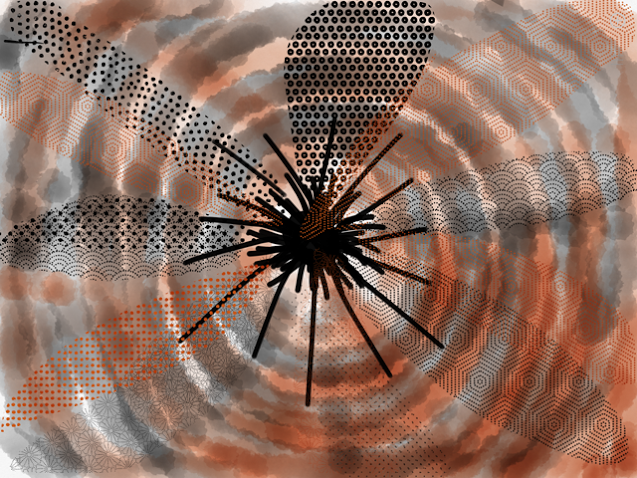
In the image above (created on my iPad using Sketches), I crack a peephole into my teaching experiences. This takes me along lines that touch/feel/see and explore students’ learning experiences. The darkness of this peephole is illuminated by the impact of sharing.

When I draw on students’ personal learning experiences from incidents in their Obstetrics rotation, I encourage them to engage in meaningful dialogue with their clinical partners who become their critical friends. Students voice their insights and their narratives to/with each other. There appear to be overlapping circles that are shifting darkness into light.  Feedback indicates the positive responses as perspectives are changed and expanded. There is a refocus, like the changing lenses used by Ophthalmologists, sliding/slipping between/in/through each other to improve our vision, enhancing self-evaluation and open-mindedness (Costas & Kallick 1993).


Costa, A. & Kallick, B.1993. Through the Lens of a Critical Friend, Educational Leadership 51:2: 49–51.

Friday, 24 April 2015

Intermingling interconnections

Displaying IMG_1431.JPG

As we dissolve disciplinary boundaries through opening up interactive smooth spaces in the curriculum, exciting processes seem to emerge. In my recent student workshop with 4th Year medical students, I handed out A4 pieces of paper on which I had printed the outline of a circle (about 10cm diameter). This followed my earlier trial run in which blank paper was given to the first group of students in 2015 - an effort to move beyond written and oral text. This time, like before, I asked students to draw something about their experiences using shared boxes of pastels - a reflection on their 8 weeks immersed in the practical realities connected to and with/in Maternal Obstetrics facilities.

What appeared from the students was powerful. The paper seems to act as an affective gateway to open up the individual and collective flows of intensities. The circle gives a platform from which their thoughts can emerge. It facilitated their focus on themselves with many students using it as an outline of their face. Red was a dominant colour chosen by students, sometimes indicated as an association with blood and anger.

Some students illustrated the stark contrasts in their experiences between the good and bad, happy and sad, a common trend with the previous group, while others moved further into metaphorical depictions of their memorable encounters. For example, in the circle one students drew a scene of crocodiles with mouths open looking at a stick person harnessed and hanging down in the centre. Another striking image depicted a tearful face with sadness in the circle, framed by flags from a variety of African countries. This links to the poor quality of care frequently experienced by foreigners, exacerbated by the language barriers - a common theme in our classroom discussions and roleplays, resonating with the shocking xenophobic attacks presently hitting South Africa. This drawing and the others are acting as a connecting medium to pull together-apart the meanings of students' clinical encounters with larger societal issues (Barad 2007). The artefacts generated from the group become a force to open up injustices that shape behaviours inside and outside the Obstetrics facilities.

The drawings and particularly the circle outline appear to contribute a valuable component to the student engagement. This supplements their online reflective task which uses the Six Step Spiral for Critical Reflection - a spiral framework. and their classroom role playing of critical incidents. Through these practical activities, a diffractive process is emerging with an expansion of our mutually generated knowledge in an effort to engage with challenging issues in student learning.  Perhaps the challenges of the disrespect in Obstetrics can be likened to the waves in the ocean confronting an obstacle causing diffraction as described by Karen Barad.

Only one student out of 32 chose to use the flip side of the paper that was blank.  The drawing on the landscape orientation of the paper illustrated a graph with strong gradients where each of the descents were accompanied by text describing the challenges faced by some mothers in labour.

My image above was created as a response to the student drawings. I used You Doodle on the iPad which enabled me to connect my ideas about the impact of the circle on the blank paper and the spiral framework that the students find helpful to guide their thinking. In the light of the context of student learning in Obstetrics, the central flipped, sepia circle indicates the smoothness of the clinical space that students are immersed in, where the unknowns and uncertainties especially during night time shifts challenge students in unexpected ways.

Tuesday, 21 April 2015

Positioning positionality


“Becoming involves dynamic processes, through/with/in which an assemblage is constantly changing through connections it is making” Sellers 2013)

Interviewing my research participants provides the traditional core material for my data collection. The conversations are recorded and transcribed. However my additional request for drawings that summarize our discussions seems to contribute a very different dimension to these interviews. I give a blank A1 piece of paper with a set of pastels and markers to each of the interviewees, many of whom are in leadership positions. Their responses have made a significant mark on my findings. The very different behaviours seem striking and relevant.

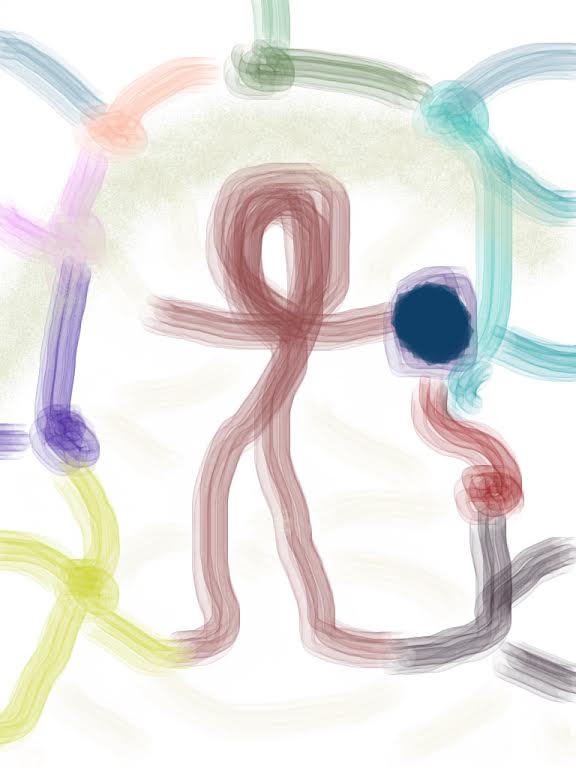
In the image above (drawn using my finger on the Paper app on my iPad) I have sketched the physical positions that were taken up by different individuals. One educator chose to remain sitting opposite me across her desk. She was very uncomfortable drawing. Only the red marker appealed to her.  She willingly used text rather than images to describe the organization of student learning.

Moving in a clockwise direction on my drawing , another educator (who I know well through social circumstances) took on a childlike role to find a comfortable space on the floor (despite a knee injury) and engaged deeply with metaphorical concepts to explain her idea of a nurturing curriculum as opposed to one where there is “a hob-nailed boot” (Edu 3).

For each interview, there has been a choice of venue (where they would feel comfortable) resulting in our meetings happening in their educators’ offices and communal meeting areas.  In terms of the positions taken up for the drawings, in most cases the educators have chosen to sit next to me at a table explaining their thoughts and ideas.  

In common with some medical students who are finding free drawing “difficult”, one educator  only agreed to do a drawing on my third and final request. She went outside her office after our discussion to find a small table. The large paper offered to her was folded then covered by a smaller familiar A4 piece of paper placed on top of it. She was clearly uncomfortable with a changed tone of voice and a rushed product.

My fifth drawing illustrates another respondent who chose to move to her large windowsill area where there was a magnificent view across Cape Town. She also needed some persuasion and remained silent for a long time as she considered what and how to draw. A few small images emerged.

These drawings seem to be deterritorializing my thinking. There are ruptures happening in the process that send me on new lines of flight (Deleuze & Guattari 1987). Is the agency of the paper debilitating some of these educators in leadership positions. Research and publications are key factors that dominate Higher Education practices - is the paper and request for images illuminating the schism between past practices and the present technology driven learning that promotes visual thinking? How can pedagogical practices adapt to such varying performativity?

Deleuze, G., and F. Guattari. 1987. A thousand plateaus: Capitalism and schizophrenia. Trans. B. Massumi. Minneapolis, MN: University of Minnesota Press.

Sellers, M. 2013. Young children becoming curriculum: Deleuze, Te Wharriki and curricular understandings. Routledge.

Tuesday, 14 April 2015

Threshold thoughts


As I move beyond arborescent thinking (described in a previous blog) I recognize the nomadic nature of my explorations in seeking out the multiplicities that characterize the context of my project. Rather than binary thinking from taken-for-granted beliefs, there is an open space filled with intensities swirling around me. Is this a threshold in my research in which I traverse a liminal space, before moving into a new position or is the new place rather an unknown space that is self-generated?

Deleuze and Guattari (1987:153) claim that the “organ changes when it crosses a threshold, when it changes gradient”. In the assemblage of my research, where are the “organs without bodies”?.As I interrogate my own positionality perhaps I am finding moments of deterritorialization that disturb my expectations. When some intra-actions strike me as exceedingly relevant, is this a strengthening of the gradient through the degree of intensity. For example when a student walks away from a challenging issue, it could be that the student’s own agency to confront dissonance within the hierarchy of medicine is driven to a reductionist position through the flow of intensities. Deleuze and Guattari (187:155)  write about horses in training where “humans impose upon the horse's instinctive forces transmitted forces that regulate the former, select, dominate, overcode them”.

In the image above, using ASketch on my iPad I have tried to capture the glows or circles of intensities that are influencing my conscious thinking through their crisscrossing energies that are driving my thoughts in different ways.

Deleuze, G., & Guattari, F. 1987. A thousand plateaus: Capitalism and schizophrenia (B. Massumi, Trans.). Minneapolis: University of Minnesota Press.

Tuesday, 7 April 2015

Interrogating inter/intraviews


Interviews are the building blocks of most qualitative research projects. Ethics committees check that the researcher has a clear plan and understanding for pulling out key data through analytic frameworks such as themes and subthemes. These structured classifying frameworks and processes are possibly facilitating us missing important issues and thus inadvertently strengthening the gap between theory and practice.

Referring to Karen Barad’s work, there seems to be scope for digging differently. Rhizomatically thinking, we ought to be able to create more tunnels like earthworms, as suggested by Barad (2014:168) thereby “iteratively intra-acting, re-diffracting, diffracting anew”.

Peterson (2014, citing Stainton-Rogers) suggests we move away from static data that focus purely on human interactions. There needs to be a broader appreciation of the dynamic construction of knowledge through time, matter and space. Interviews should rather be considered as intra-views that consist of “a set of material-discursive intra-actions” (Peterson 2014:41). Data can be replaced by “creata”. Furthermore, by embracing Barad’s concept of relational performativity where matter matters, Peterson recommends that data be transformed to “relata” - what relates. Relata emerge through the intra-actions that form part of phenomena within the apparatus of the interview situation.

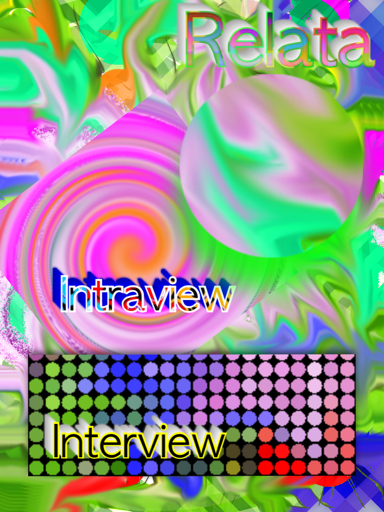
Using You Doodle on the iPad, the image above demonstrates my shifting understanding of meaning-making from interviews. The rectangular shape at the base represents the structured and linear classification of findings used in conventional interview data collection processes. The blurred circle of colour floating under the text shows where I am moving. The middle shape was created by cutting, pasting and swirling the patterns to form a different image indicating how we can work through and with an intra-view that then releases relata.

Barad, K. 2014. Diffracting diffraction: Cutting together-apart. Parallax. 20:2:168-187.

Peterson, K.S.  2014. Interviews as intraviews: A hand puppet approach to studying processes of inclusion and exclusion among children in kindergarten. Reconceptualizing Educational Research Methodology. 5:1.

Sunday, 29 March 2015

Climbing out of the tree


“All of tree logic is a logic of tracing and reproduction … The tree articulates and hierarchizes tracings; tracings are like the leaves of a tree” Deleuze and Guattari (1987).
Trees are such a familiar metaphor used in many disciplines. One of my research participants compared student learning to a seed that gets nurtured to grow into a healthy plant, possibly a tree. However Deleuze and Guattari (1987) suggest an expanded theoretical approach in which we ought to theorize beyond trees and tracings - rather rhizomes and mappings through which we can explore more possibilities. A tree symbolizes a fixed and static genealogy where our “being” and position matter, and a tracing is reproductive rather than productive or generative.


In the dynamic flow of this research, I am shifting and becoming rather than being. There is fluidity in the process. Recently I was asked where I stand in terms of my ontological position? In considering Barad’s (2007) material-discursive interconnections, I wonder if I can truly name a position. I’m moving along unpredictable lines, working through a dynamic diffractive approach that is putting me in an in-between space in time/with time where I am becoming through the unfolding, infolding and refolding of emerging data. Rather than sitting on a branch, or connected to the trunk I am exploring different routes, creating new ones as layers of data are explored, as meanings fold and unfold through each other. In this mangle of entanglement, I am “part of the mix” (Greene 2013:751).


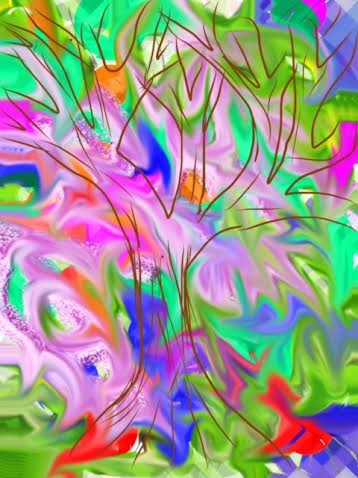
As I map my way through the emergence of newness, I become sensitive to forces and flows that move me away from tracings over given, structured concepts and categories - away from places where points are plotted with a fixed order (Deleuze & Guattari 1987). In the image above I have tried to capture this flow and movement in which I am immersed. The array of colours and swirls highlight the forces that have shifted me out of the tree. I used You Doodle on the iPad then added a layer with Adobe Ideas.


Barad, K. 2007. Meeting the universe halfway: Quantum physics and the entanglement of
matter and meaning. Durham, NC: Duke University Press.


Deleuze, G., & Guattari, F. 1987. A thousand plateaus: Capitalism and schizophrenia (B. Massumi, Trans.). Minneapolis: University of Minnesota Press.


Greene, J. C. 2013. On rhizomes, lines of flight, mangles, and other assemblages, International Journal of Qualitative Studies in Education, 26:6, 749-758.