Tuesday, 24 March 2015

Mandala magnetism


What about the optical patterns that we see and see us?

Working in the in-between space, the emerging data in this project are influencing me by transforming my knowing and being. Hultman and Taguchi (2010:537) explain a relational materialistic approach in which “a diffractive ‘seeing’ or ‘reading’ the data activates you as being part of and activated by the waves of relational intra-actions between different bodies and concepts (meanings) in an event with the data”.

A mandala, recently drawn in pen by a student has captivated my attention - a magnetic appeal. It stood out for me among the group of 25 drawings. It has acted as a constitutive force working on me. The image depicted a baby in the centre surrounded by words reflecting the student’s feelings and thoughts, written in text going round in a spiral path. Perhaps the movement of shifting the paper while writing in a circular manner combined with the symbolism of a mandala was cathartic for this student.

My image here was created with the Kaleido App on the iPad - a simple mechanistic mandala. Colour effects on Word enabled me to soften the hues. The layers and patterns with radiating concentricity give meaning to the many connections that are appearing in my research project.

Hultman, K & Taguchi, H.L. 2010. Challenging anthropocentric analysis of visual data: a relational materialist methodological approach to educational research, International Journal of Qualitative Studies in Education, 23:5, 525-542.

Saturday, 21 March 2015

Behind my blogging


Why am I using images with text in my blogs? I am not an artist or art therapist nor do I have any training in design. I do though love patterns, colours and movement - and my iPad. In this research project I plan to cut into the process through these visual texts - self-generated data emerging through an iterative process - data-in-the-making, “enabling newness to come into existence; the ‘more-than’ of data” (Springggay & Zaliwska. 2015:137).

Apart from the artefacts, these drawings provide a “trace of the thinking process” through marks that reveal emotions, force and other characteristics depending on the medium and tools used (Taylor 2008). I am creating and recreating agential cuts (Barad 2007).

Sapochnik (2013) points out that drawings have the “potential to (at least, to some extent) circumvent the work of internal censorship and allow access to more elusive sources of meaning”. There is an intra-action of forces happening and emerging.

Through the affordances of the iPad, I can choose different Apps to create two-dimensional representations that are free flowing without the resistance of paper or tools. There is a playful element as I explore and engage with the digital space.

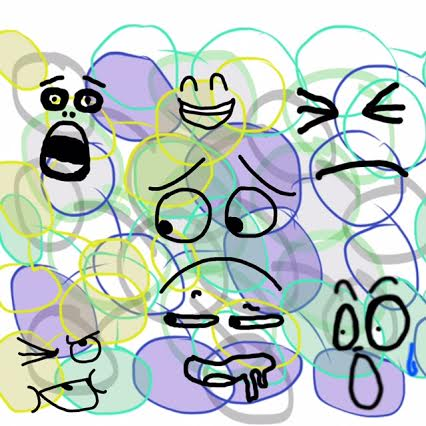
Here I have superimposed faces from the iPad App called Cool Faces onto my design from the previous blog. The facial expressions allow me to highlight the importance of acknowledging emotion and affect in my work and research - an aspect of medical care that is frequently under-represented.


Sapochnik, C. 2013. Drawing below the surface: Eliciting tacit knowledge in social science research. Tracey. Drawing knowledge. http://www.lboro.ac.uk/microsites/sota/tracey/journal/edu/2013/sapochnik.html

Springggay, S & Zaliwska Z. 2015. Diagrams and Cuts: A Materialist Approach to Research-Creation. Cultural Studies ↔ Critical Methodologies. 15:2:136-154.


Taylor, A. 2008. Re:Positioning drawing. In Garner, S. (ed) Writing on Drawing Essays on Drawing Practice and Research. Chicago. Intellect Books.

Wednesday, 18 March 2015

Digging deeper into diagramming


The process of image-making as a reflective tool continues to intrigue me. In this drawing with entangled circles, some complete others open, I used Adobe Ideas on the iPad to enable me to create the different layers that illuminate what is included and excluded in my research exploration. Looking through these different lenses brings alternative and multiple insights.

When interpreting the artefact, the product of the finished drawing, a multimodal semiotic approach can be useful (Jewitt & Oyama 2001). It provides a framework to make meanings from what is said and done with the images in terms of social, moral and political representations, Yet, there seems more to gain in exploring the process. Is a drawing ever finished?

As I explore the “abstract machine” of images (Deleuze, 1986), I am drawn to the concept and process of “pure edging” which orientates us “toward new positions, bodies, and forms as more-than” (Springggay & Zaliwska 2015). In my research project, I am entangled in the event of Obstetrics learning, digging at the edges of a hole of sensitivity; keeping the (w)hole without dislodging the soil.

Immersing myself in the emerging data through the research process, reveals potential cracks. For instance negotiating entry into challenging contexts can be problematic. I sit on the “edginess of the process and experience” (Springggay & Zaliwska 2015:142). Fortunately there are pillars of support around me.


Jewitt,C & Oyama,R. 2001. Visual Meaning: A social semiotic approach. In (eds.) T. van Leeuwen & Jewitt, Handbook of visual analysis. London: SAGE.

Springggay, S & Zaliwska, Z. 2015. Diagrams and Cuts: A Materialist Approach to Research-Creation. Cultural Studies ↔ Critical Methodologies. 15:2:136-154.

Tuesday, 17 March 2015

Pulling together apart

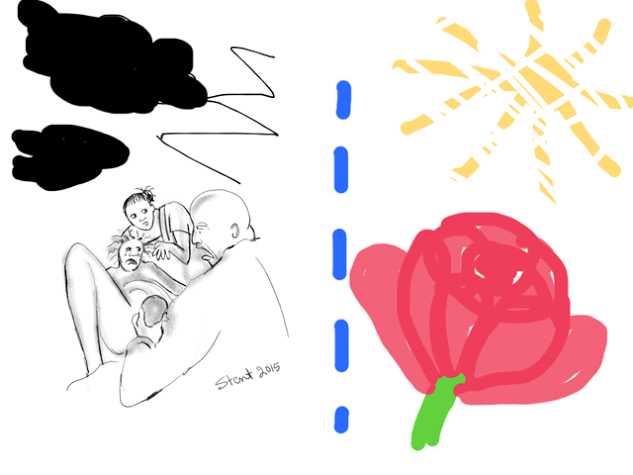
contrasts.png
The material practice of drawing may be viewed as an 'agential cut' which according to Karen Barad is an intra-active movement in material-discursive practices. It “enacts a causal structure among components of a phenomenon in the marking of the ‘measuring agency’ (“effect”) by the measured object’ ("cause")" (Barad 2007).

“Different 'agential cuts' produce [and materialize] different phenomena” (Barad 2007).

In our first workshop for 2015 I tried something new, asking students to draw their reflections. These Year 4 students had just completed their initial 8 week Obstetrics rotation - a time in their becoming doctors that is acknowledged as momentous when they begin to feel like a ‘real’ doctor. One of the aims of the participatory classroom session is to motivate students to become advocates for change through a collaborative approach.

The energy of the group during this workshop was palpable. They shared their good and not so good experiences through numerous roleplays, conversations and drawings. What struck me in their images that were mostly drawn with pastels, were the contrasts revealed by the students through their happy and sad visualized encounters, light and dark shadings and their use of metaphors such as pandora’s box, a green healthy tree bearing fruit versus one that was bare and burnt-out, and hearts that were broken yet covered with compassionate text. 

Support through the department and Faculty is offered to students throughout their studies.

I felt drawn to two images in particular. One was of a mandala using successive circles of text. It made me feel that perhaps the action of writing in a circular way was cathartic to the student. Another was a vivid rectangle with dense colour and thickness indicating intense pressure placed on the paper. Was this student indicating an intensity of emotion or containment within the fixed rectangular shapes?

Feedback from the students in terms of drawing images indicated that they mostly appreciated using this extra tool to unpack their experiences and to use their creativity that is often kept hidden as they work themselves through a very structured and fact-filled curriculum. However some students expressed discomfort working in the visual medium.

In the image above I have borrowed ideas to depict these contrasting encounters and emotions that our students witness during their Obstetrics rotation. Using Explain Everything on my iPad, I have included an image drawn for me by a local artist, Stacey Stent.

Barad, K. 2007. Meeting the universe halfway: Quantum physics and the entanglement of matter and meaning. Durham, NC: Duke University Press.

Tuesday, 24 February 2015

Matter entangled with power


Joyner, Shefer & Smit 2014:45) state that “the discourses and practices shaping institutionalised nursing internationally, coupled with local historical legacies of gender, class, racial and socio-cultural inequalities, diminish the possibility of democratic, socially responsive and humane care in South African healthcare institutions”.

Matter is entangled in the power relations that play out in the health system and are particularly evident in Obstetrics. Our students, in their being and becoming doctors, get caught in these intra-actions. Materiality matters in maintaining the status quo of a system that is strongly influenced by surveillance and fear.

This hierarchical division of labour is entrenched in the South African health system in (Joyner, Shefer & Smit 2014:40). It is represented by symbolic emblems that mark the rank and status of each actor, and subsequent power. The white coats and stethoscopes indicate those with an MBChB qualification and beyond, while the nursing profession wear epaulette bars of different colours to show the categories of nursing in which they are registered and enrolled. These distinguishing devices, (as named by the South African Nursing Council) make visible their rank and responsibility. For instance a green bar signifies midwifery expertise.
Our students enter and exit from this system during their clinical block rotations. Their student cards give them access to the facilities where they learn the skills to become competent as indicated by the curriculum requirements. In Obstetrics, the sign-off of deliveries becomes the pot-of-gold that determines students’ agency. At times they feel helpless when caught in the entanglement of the web of relationships within the health team. When uncaring behaviours are witnessed, there is evidence that they emanate from all ranks within the hierarchy. While disciplinary processes are in place with complaints procedures through various mechanisms, the power relations do not encourage responsible responses to promote accountability.
This image (created on Adobe ideas) represents the entangled nature of the relationships present in the learning environment of Obstetrics. I was imagining a flattened relationship between all the actors in the Maternal Obstetrics Units. How different would it be if these markers of rank were removed?
Joyner, K., Shefe, T. & Smit ,E.  2014. Discourses and practices in institutionalised nursing in South Africa: Challenges for care, South African Review of Sociology, 45:3, 34-5.

Sunday, 15 February 2015

Glow glimmers


The design and arrangement of public birthing facilities has emerged as a key theme in my research. Much of this reflects a hierarchical and biomedical approach whereby efficiency for the medical team appears to override patient comfort. For instance, curtains that separate cubicles tend to offer little privacy, contributing to the prevalent disrespect. When a woman screams or a midwife shouts, everyone hears it.

Last week I was invited to walk around the labour ward in a local hospital after interviewing one of the educators there. I took a photo of the recently decorated room for mothers experiencing neonatal deaths. What struck me was the difference between this room and the starkness of the other spaces. It had curtains with colour, pictures on the walls, with a large lamp and clock as prominent features.

In the image above, using iPastels on the iPad, I added colour and patterns to demonstrate the entangled relationships. The pastels enabled me to blur the colours to depict the complex intra-actions that manifest in this space.


Drawing on the significance of the materiality of the labour wards, I recognize the glow that emerges from this visit – a sense of pulling in. This feeling is affirmed by MacLure who recommends that we take a novel stance with data collection by suggesting that “in the research relation with data, we must be invited in” (2013:662). 

MacLure, M. 2013. Researching without representation? Language and materiality in post-qualitative methodology, International Journal of Qualitative Studies in Education, 26:6, 658-667.

Sunday, 8 February 2015

Speaking Silence


The invisibility of disrespect in Obstetrics can be viewed as “desiring silence”. Such “silent discourses serve to maintain a status quo … [and are] produced by a longing for maintaining a normative and unchallenged (even unrecognized) belonging (status) that is important” (Jackson & Mazzei, 2012:100).

Recently I was surprised by two students who insisted that their reflective commentaries should remain private without any sharing with colleagues, even anonymously. While the reflection on a challenging incident was troublesome, the other was complimentary of a clinical educator displaying great skill and empathy.

While reading, Thinking with theory in qualitative research (Jackson & Mazzei, 2012), I realized the value of exploring what is producing the silence in medical education, and what the silence is producing. The forces and actions of the silences provide channels to unpack the many issues that are emerging from my interviews such as the medical hierarchy, professional silos, status and power. The institutional teaching machine is embedded in these silencing desires. Students learn to be strategic to work with and among the silences - not to compete with their desires for success. Deleuze and Guattari's work becomes more important to me as I investigate these silences and desires.

Jonathan Jansen, the Vice Chancellor of the University of the Free State has challenged the silences in South African society and Higher Education Institutions. He has transformed racial practices and cultures through engagement and dialogue. By developing an authentic learning intervention that promotes dialogue, there is a chance for the opening up of silences to explore the desires.


The image above was created using Notability on the iPad. I see my research as the blue arrow entering this vast space of intra-actions related to “desiring silences”. I will seek “to understand the confluence of interests that both produce desire, and that desire seeks to produce and/or protect" (Jackson & Mazzei, 2012:96).